Mark Jherico
Magno
I build AI agents, custom API integrations, and automation systems that run quietly on a server somewhere — handling the boring stuff so people can focus on the work that matters.
What I build
AI Agents
Smart-reply bots, classification systems, and decision agents that read messages, understand intent, and respond appropriately. Built on Claude and OpenAI APIs.
API Integrations
Reverse-engineering internal APIs, handling cookie/OAuth auth flows, building rate-limited workers that run 24/7. Webhook ingestion and Slack delivery.
Dashboards
Custom Express + MongoDB apps that aggregate data from multiple sources into one view. Built when no off-the-shelf tool fits the workflow.
AI Video Pipelines
End-to-end video production from a single command — script, voice, avatar, images, animation, and FFmpeg assembly into a finished MP4. ElevenLabs, Hedra, FLUX, Kling.
Selected work
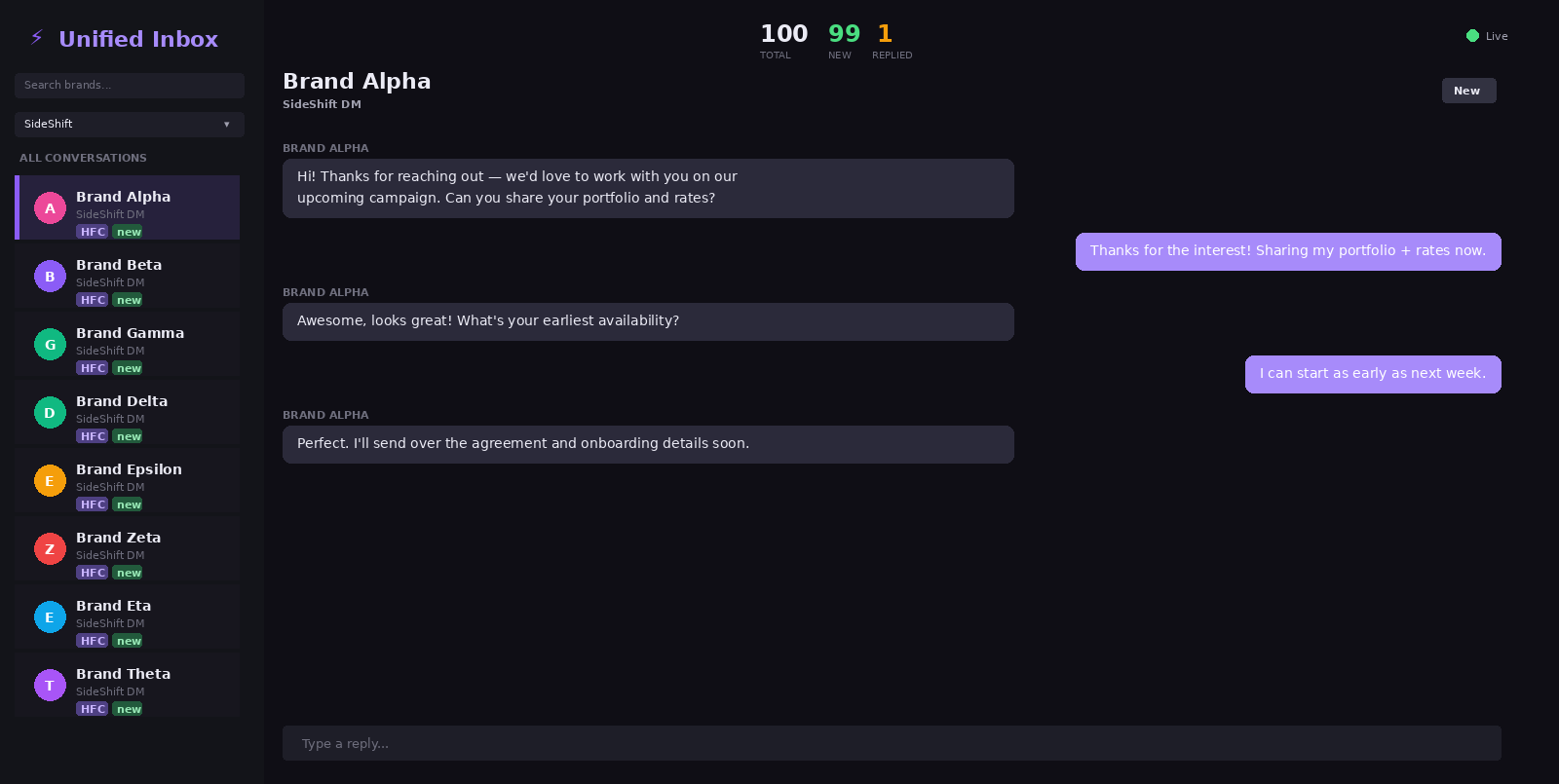
A multi-platform conversation aggregator that pulls inbound messages from four different services into a single dashboard.
The client was managing brand conversations across multiple messaging platforms with different APIs, auth flows, and message schemas. Each platform had its own quirks — one used cookie-based auth with a short-lived token, another required webhook ingestion, a third had a polling-only interface.
- Built normalization layer to unify message schemas across 4 platforms
- Implemented auto token refresh on a 50-minute interval to avoid auth drops
- Per-platform error handling and retry logic for failed message fetches
- Single Express server with platform-specific service modules
- Replaced the habit of switching between 4 separate apps with a single tab
- Cut average time-to-first-reply by an estimated 60–70%
- Auto token refresh eliminated daily manual re-auth across two platforms
- Running stable in production since launch with no missed message incidents
An auto-reply bot for a third-party messaging platform that classifies inbound brand messages and responds with smart, context-aware replies.
The client was getting 30+ inbound brand inquiries per day and replying manually, often with delays. I reverse-engineered the platform's internal GraphQL API (cookie auth, undocumented token refresh flow), built a Node.js service that polls for new messages, classifies them by intent, and sends a templated reply customized to the inquiry type.
- Handles 7 distinct inquiry categories (rates, portfolio, booking, retainers, etc)
- Templated responses with LLM-assisted personalization to avoid robotic feel
- Runs 24/7 under PM2 with Slack alerts on errors or auth expiry
- Reduced response time from hours to seconds
- ~30 inbound inquiries handled automatically per day
- Estimated 1.5–2 hours of manual reply work saved daily
- Response time dropped from several hours to under 30 seconds
- Smart classification routes ~85% of inquiries to the right template on first pass
// classify inbound message → route to template
async function classifyAndReply(message) {
  const intent = await classifyIntent(message.body);

  if (!TEMPLATES[intent]) {
    await slackAlert('unknown intent: ' + intent);
    return;
  }

  const reply = await personalize(TEMPLATES[intent], message);
  await sendReply(message.threadId, reply);
  log({ intent, threadId: message.threadId, at: Date.now() });
}
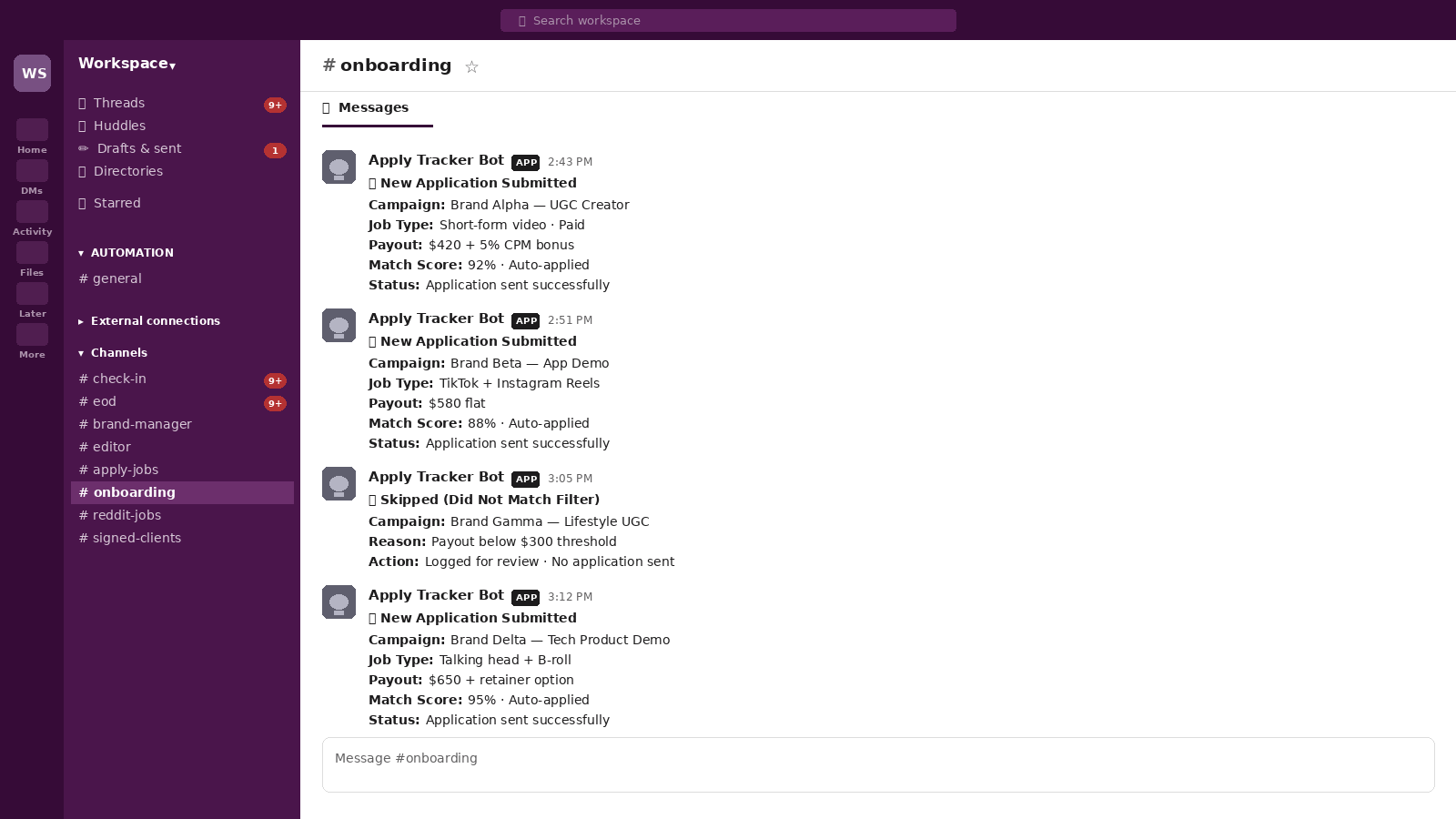
A rule-based agent that filters inbound campaigns from a creator marketplace and auto-applies to qualified ones, then pushes summaries to Slack.
The marketplace had hundreds of new campaigns daily, most of which didn't match the client's criteria. Reviewing manually was eating into actual creative work time. I built a worker that pulls new campaigns on a schedule, runs them through a strict rule filter, applies to the qualified ones via the platform's internal API, and posts structured summaries to Slack for the team to review.
- Strict rule-based filtering — no AI hallucination risk on apply decisions
- Structured Slack summaries grouped by campaign type
- Audit log of every application sent, for client review
- Automated 200+ daily evaluations down to ~10 actually-relevant applications
- 200+ campaigns evaluated daily, ~95% filtered out automatically
- Estimated 3–4 hours of manual review work saved per day
- Zero false-positive applications since the rule filter went strict
- Slack summaries gave the team visibility without anyone watching the platform
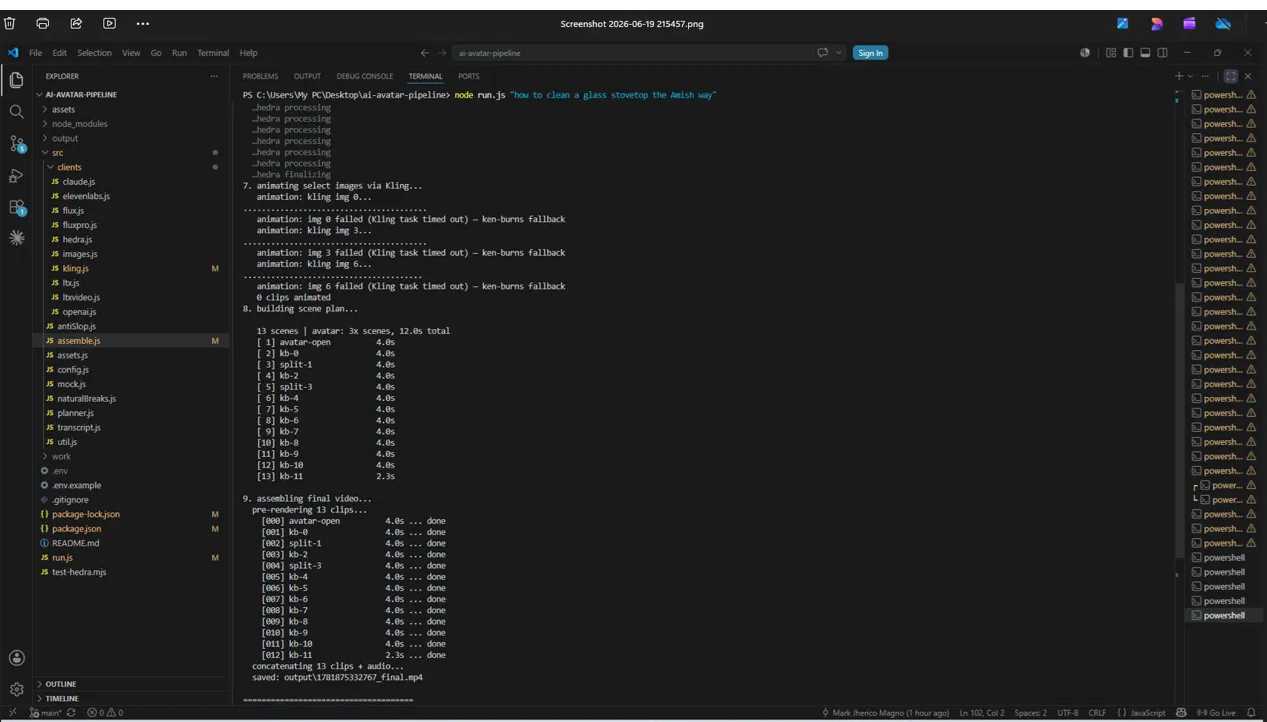
An end-to-end AI video production pipeline that takes a topic and produces a finished MP4 — script, voice, avatar, images, animation, and assembly — with one command.
Built for a client running a faceless YouTube channel. The pipeline needed to match a specific scene grammar: avatar appears 2-4 seconds, switches to zoomed still images, animated clips, and split screens — all cutting on natural voiceover pauses detected from ElevenLabs speech alignment data.
- Claude API generates the script; ElevenLabs (Daniel voice, turbo model) produces voiceover with word-level timestamps
- Natural break detection parses alignment data to find speech pauses — every scene cut happens exactly there
- FLUX Pro generates images using a 2014 smartphone aesthetic prompt + 8-photo reference grid
- Hedra API produces the AI avatar clip (4 seconds max, with audio compression to reduce mouth exaggeration)
- Kling animates every 3rd image; FFmpeg pre-renders each scene clip then concatenates with audio into final MP4
- Scene grammar enforces: avatar open → ken burns → animated → split screen → repeat, max 3 avatar appearances per 60s
- Full pipeline in Node.js — one command produces a complete MP4
- FFmpeg pre-render approach fixed scene-switching bug caused by filter_complex race conditions
- Reference image grid builder merges 8 photos into 4×2 layout passed to FLUX as style reference
- Avatar reuse logic saves expensive Hedra API credits across multiple pipeline runs
- Mock image mode with distinct colors for fast pipeline testing without burning API credits
// one command → finished MP4
const script   = await generateScript(topic);
const voice    = await generateVO(script, audioPath);
const scenes   = getSceneDurations(voice.alignment);
const images   = await generateImages(topic, count);
const avatar   = await generateAvatar({ imageBuffer, audioBuffer });
const animated = await animateImages(images);
await assembleVideo(scenePlan, audioPath, outPath);
Recently shipped
- Jun 2026 AI video pipeline. Built end-to-end Node.js pipeline — Claude script, ElevenLabs voice, Hedra avatar, FLUX images, Kling animation, FFmpeg assembly. Natural break detection cuts scenes on speech pauses.
- Apr 2026 Auto-apply tracker. Built a rule-based agent that filters 200+ daily campaigns down to ~10 qualified ones, with structured Slack delivery and audit logging.
- Mar 2026 AI smart-reply agent. Reverse-engineered an undocumented GraphQL auth flow (cookie + 50-min token refresh), shipped a 24/7 Node.js classifier handling 7 inquiry categories.
- Feb 2026 Unified inbox dashboard. Express + MongoDB aggregator pulling conversations from 4 platforms into a single UI with per-platform normalization.
Stack & tools
About me
I'm a BSIT student based in the Philippines, currently working as the technical operator for a US-based content creator client.
My day-to-day is a mix of building new automations, maintaining the ones already in production, and figuring out which manual workflow is the next one to kill. I work most comfortably when I'm given a problem instead of a spec — the part I enjoy is mapping the workflow, finding the bottleneck, and shipping the smallest version that works.
Outside client work I'm in school full-time taking DBMS, Java, C, and Discrete Math. The classroom side keeps the fundamentals sharp; the client side keeps the edges practical.
I'm available for full-time work. If you've got a workflow that should be automated and isn't, I'd like to hear about it.
Let's build something.
Available for full-time work. Async communication preferred.